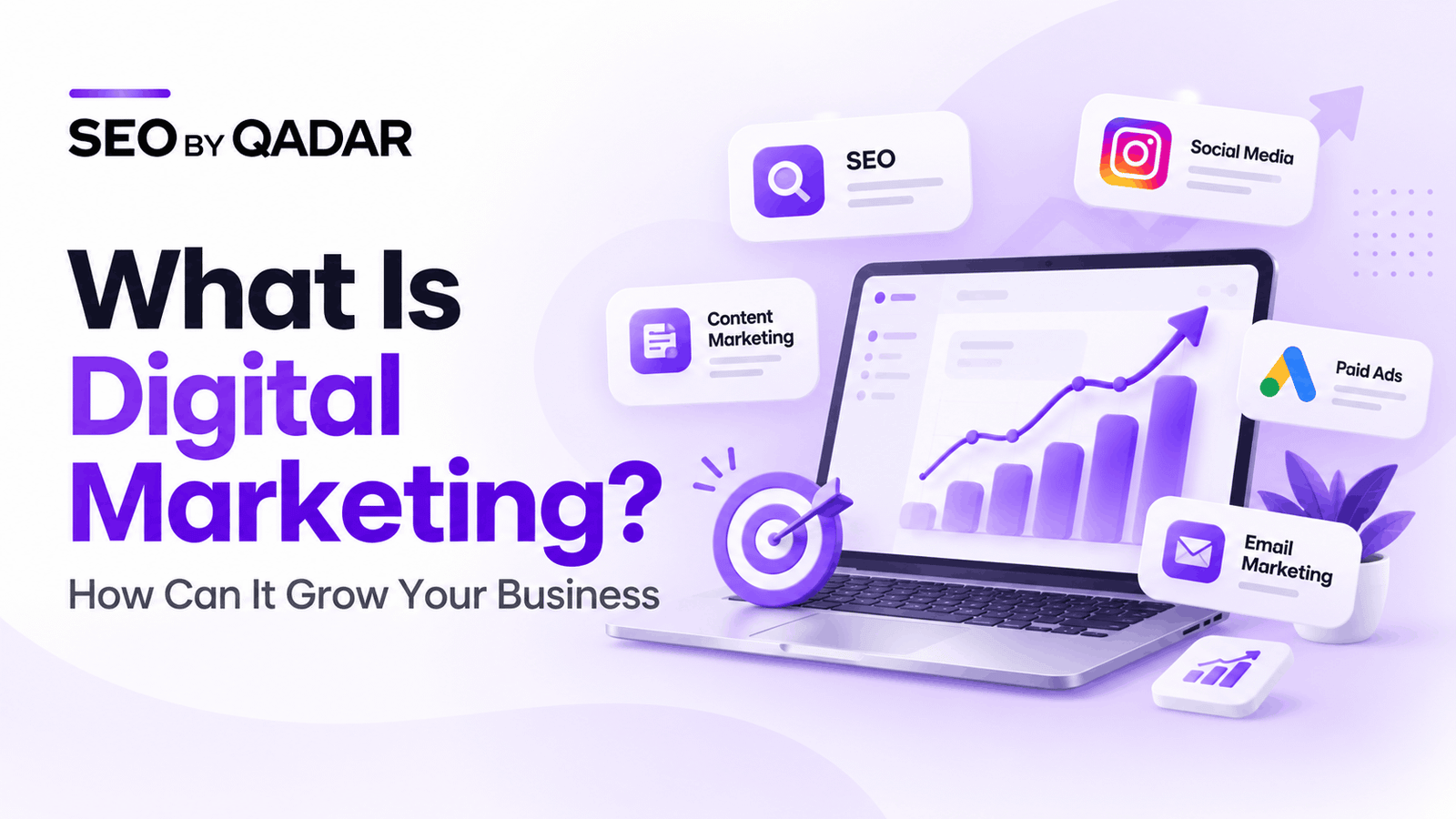
Digital marketing is the use of online channels such as search engines, websites, social media, email, content and paid advertising to reach potential customers and turn their interest into measurable business results.
For a business, that may mean appearing when someone searches on Google, reaching the right audience through social media, bringing people to a useful landing page, collecting enquiries, selling products online or staying connected with existing customers.
The important point is that digital marketing isn’t one activity. It is a connected system.
SEO can bring a potential customer to your website. Good content can answer their questions. A clear website can help them understand your service. Social media can keep your brand visible. Paid campaigns can reach selected audiences faster. Analytics then show what people actually did.
Businesses don’t need to use every channel at once. They need the right mix based on where their customers are, what they are searching for and what action the business wants them to take.
Why Digital Marketing Matters for Businesses Today
Your customers are already online.
DataReportal’s 2026 mid-year research estimated 6.12 billion internet users worldwide, representing about 73.8% of the global population. The same report estimated 5.79 billion social media user identities, while 79.3% of surveyed online adults reported using search engines and web portals. Social-media identity figures may include non-unique accounts, so they shouldn’t be interpreted as an exact count of individual people.
Source: DataReportal – Digital 2026 Mid-Year Global Update
That scale changes how businesses find customers.
A person who needs an accountant may search Google. Someone looking for a restaurant may check Maps and social media. A company researching an SEO agency may read service pages, case studies and reviews before making contact.
Digital marketing puts your business into those moments.
The Role of Different Digital Marketing Channels
| Digital Channel | Main Purpose | Example Business Goal |
|---|---|---|
| SEO | Gain organic search visibility | Generate enquiries from Google |
| Content Marketing | Answer questions and build trust | Educate potential buyers |
| Social Media | Build visibility and engagement | Stay in front of your audience |
| Paid Advertising | Reach selected audiences quickly | Generate traffic or leads |
| Email Marketing | Communicate with existing leads and customers | Nurture prospects and repeat buyers |
| Website and CRO | Turn visitors into actions | Calls, forms, bookings or sales |
| Analytics | Measure performance | Find which channels produce results |
Digital Marketing Basics: How Does It Actually Work?
A practical digital marketing strategy usually follows a simple path:
Attract → Educate → Build Trust → Convert → Retain
Imagine a potential customer needs a service.
They search for an answer on Google and discover one of your pages. They read the page and understand that you provide the service they need. They then check another page, your reviews or social profiles before deciding whether to contact you.
Each touchpoint has a different job.
Digital marketing works best when those touchpoints support each other instead of operating as separate campaigns.
1. Attract the Right Audience
Getting more website traffic isn’t automatically a business win.
The goal is to attract people who are genuinely relevant to your products or services.
For example, an SEO company doesn’t only need thousands of visitors interested in general marketing news. It needs visibility for searches made by business owners who need SEO, website optimization, local visibility or digital growth support.
This is where targeting and search intent matter.
2. Give People the Information They Need
Once someone reaches your website or social profile, the content needs to answer their questions:
- What you provide.
- Who the service is for.
- How it solves their problem.
- What makes the offer credible.
- What they should do next.
Google also recommends creating helpful, reliable, people-first content instead of producing pages primarily to manipulate search rankings.
Reference: Google Search Central – Creating Helpful, Reliable, People-First Content
Good digital marketing therefore doesn’t begin with repeating keywords. It begins with understanding the person behind the search.
3. Turn Interest Into an Action
A marketing campaign only becomes commercially valuable when it supports a meaningful action.
Examples include:
- Submitting an enquiry.
- Calling the company.
- Sending a WhatsApp message.
- Booking an appointment.
- Requesting a quotation.
- Purchasing a product.
- Signing up for a trial.
- Joining an email list.
This is why marketing strategy and website experience should work together.
What Are the Main Types of Digital Marketing?
Most businesses use a combination of channels rather than depending on one.
1. Search Engine Optimization (SEO)
SEO improves how a website can be discovered through search engines such as Google.
Key SEO activities include:
- Keyword and search-intent research.
- On-page optimization.
- Creating useful content.
- Technical SEO.
- Internal linking.
- Website performance optimization.
- Local SEO.
- Off-page authority building.
Google describes SEO as helping search engines understand content while helping users find a site and decide whether they should visit it. Google also makes clear that there is no secret technique that automatically guarantees a number-one ranking.
Reference: Google SEO Starter Guide
Businesses that want to build their organic search visibility can explore our SEO services.
2. Content Marketing
Content marketing gives potential customers useful information before they are ready to buy.
Common content marketing formats include:
- Blog articles.
- Service guides.
- Frequently asked questions (FAQs).
- Comparison pages.
- Case studies.
- Videos.
- Reports.
- Tutorials.
- Social media content.
For example, a person searching “what is digital marketing” may not be ready to hire an agency today. But a clear article can introduce the brand, answer their question and help them understand which service they may need next.
That’s why informational content has commercial value even when it doesn’t immediately ask for a sale.
3. Social Media Marketing
Social media allows businesses to remain visible where customers already spend time.
Depending on the audience, that may include platforms such as LinkedIn, Instagram, Facebook, TikTok, YouTube or X.
The right platform depends on the business.
A B2B consultancy may get more value from LinkedIn and educational content, while a restaurant or fashion brand may depend more heavily on highly visual platforms.
Effective social media management is therefore less about posting everywhere and more about choosing the platforms, content formats and publishing rhythm that match the audience.
4. Paid Advertising
Paid digital advertising can place a business in front of selected audiences without waiting for organic visibility to develop.
Common paid advertising channels include:
- Google Ads.
- Meta Ads.
- LinkedIn Ads.
- YouTube advertising.
- Display campaigns.
- Remarketing.
Paid traffic can begin quickly, but paying for clicks doesn’t guarantee profitable leads or sales.
The landing page, offer, targeting, tracking and follow-up process still matter.
5. Email Marketing
Email marketing is particularly useful after someone has already interacted with the business.
Businesses can use email marketing to:
- Nurture leads.
- Share useful updates.
- Announce products.
- Follow up with prospects.
- Recover abandoned purchases.
- Encourage repeat business.
Unlike many social platforms, email gives businesses a direct way to communicate with people who have chosen to hear from them.
6. Website Marketing and Conversion Optimization
Your website is often where the other marketing channels meet.
SEO sends visitors there. Ads send visitors there. Social profiles link to it. Emails direct people back to it.
A website therefore needs more than an attractive design. Important pages should make the next action easy to understand.
This may involve improving:
- Website navigation.
- Mobile usability.
- Calls to action (CTAs).
- Page speed.
- Forms.
- Product information.
- Service descriptions.
7. Analytics and Performance Tracking
One of the biggest digital marketing benefits is measurability.
Businesses can track metrics such as:
- Organic clicks.
- Impressions.
- Website sessions.
- Enquiries.
- Calls.
- Form submissions.
- E-commerce transactions.
- Advertising costs.
- Conversion rates.
- Revenue, where tracking is available.
This doesn’t mean every marketing activity can be attributed perfectly. Customer journeys can involve several channels and devices.
But digital data gives businesses considerably more visibility into what people do after interacting with a campaign.
What Are the Main Digital Marketing Benefits?
Digital marketing can support business growth in several ways.
1. More Relevant Visibility
A business can target people based on what they search for, where they are located, what content they engage with or other audience signals available within the relevant platform.
This is more useful than simply trying to reach the largest possible audience.
2. Access to Local and International Customers
A small company can target one city through local SEO while another business can create an international search strategy across several countries.
The channel can adapt to the size and location of the market.
3. Better Measurement
Instead of knowing only that an advertisement ran, businesses can often measure what happened after a user saw or clicked it.
That makes it easier to compare campaigns and decide where additional investment makes sense.
4. Long-Term Organic Growth
SEO and useful evergreen content can continue attracting relevant searches after publication.
Organic visibility isn’t permanent or guaranteed, and rankings can change, but strong search assets can keep producing value beyond the day they were created.
5. Faster Testing
Digital channels also make it possible to test different offers, landing pages, ad messages, content topics and calls to action.
Businesses can use the results to refine future campaigns instead of relying only on assumptions.
How Can You Use Digital Marketing for Business Growth?
A useful strategy starts with the business goal rather than the marketing channel.
If the goal is more local enquiries, the strategy might prioritize local SEO, Google Business Profile visibility, service pages and conversion tracking.
If the goal is e-commerce sales, the focus may shift toward category and product SEO, paid shopping campaigns, remarketing and email.
If the business sells a complex B2B service, educational search content, LinkedIn visibility, case studies and lead nurturing may make more sense.
Example 1: Digital Marketing for a Local Service Business
A local home-services company might use the following customer journey:
Google Search → Local Landing Page → Trust Signals → Quote Form → Follow-Up
The purpose isn’t simply to rank for hundreds of keywords.
The goal is to be visible for commercially relevant local searches and make contacting the company straightforward.
Example 2: Digital Marketing for an E-commerce Store
An online store could use this approach:
Product and Category SEO → Helpful Buying Content → Product Page → Remarketing → Email
Here, marketing supports customers at multiple stages rather than depending only on the final product page.
Example 3: Digital Marketing for a B2B Company
A B2B company may use this customer journey:
Educational SEO Content → LinkedIn → Case Study → Consultation Request
Because the buying decision can take longer, credibility and repeated exposure matter.
SEO vs. Social Media vs. Paid Ads: Which Should You Choose?
There isn’t one correct channel for every business.
The best choice depends on your business goals, audience, budget and expected timeline.
Which Digital Marketing Channel Is Best for Your Goal?
| Business Priority | Consider Starting With |
|---|---|
| Long-term Google visibility | SEO |
| Fast audience testing | Paid advertising |
| Brand awareness and engagement | Social media |
| Educating buyers | Content marketing |
| Repeat customers | Email marketing |
| More conversions from existing traffic | Website optimization and CRO |
| Local enquiries | Local SEO and local presence |
For many companies, the better question isn’t “Which one should replace the others?”
It’s “Which combination supports our current business goal?”
Common Digital Marketing Mistakes to Avoid
1. Trying Every Channel at Once
More channels mean more work, more creative requirements and more data to interpret.
Starting with two or three well-chosen channels is often more manageable than spreading the budget across every available platform.
2. Focusing Only on Traffic
A campaign can increase website visits without increasing enquiries.
Track business actions as well as visibility metrics.
3. Publishing Content Without Considering Search Intent
A page may contain the correct keyword but still fail to answer what the searcher actually needs.
Search intent should influence the content format, depth and next action.
4. Sending Paid Traffic to Weak Pages
Advertising can’t permanently compensate for an unclear offer, slow website or confusing landing page.
The destination matters as much as the advertisement.
5. Expecting SEO Results Immediately
SEO is usually a longer-term channel.
Google notes that website changes may be reflected in Search within hours in some cases, while other changes can take several months.
Reference: Google SEO Starter Guide
A sensible SEO strategy therefore measures progress over time rather than expecting instant ranking changes.
6. Using Keywords Unnaturally
Keywords help clarify page relevance, but repeating the same phrase unnecessarily damages readability.
Google specifically warns against keyword stuffing and states that it does not use the meta keywords tag for ranking.
Reference: Google SEO Starter Guide
How to Start a Digital Marketing Strategy
You don’t need to begin with a complicated 50-page marketing plan.
Start with five questions.
1. What Is the Business Goal?
Choose something measurable. Examples include more enquiries, e-commerce sales, qualified leads, bookings or local calls.
2. Who Is the Customer?
Understand their location, problem, buying stage and the language they use when searching.
3. Where Do They Look for Solutions?
This determines whether Google Search, social media, email, YouTube, paid advertising or another channel deserves priority.
4. What Does the Customer Need Before Converting?
They may need pricing information, examples, reviews, FAQs, case studies or a clear explanation of the service.
5. How Will Success Be Measured?
Define meaningful key performance indicators (KPIs) before the campaign begins. Traffic alone may not be enough. Track the actions connected to the business goal.
Do You Need a Digital Marketing Agency?
Some businesses can manage individual digital channels internally.
Others reach a point where SEO, content, website updates, social media, design and analytics become difficult to coordinate across different people.
An agency becomes useful when the business needs specialists across several areas or wants one connected strategy rather than isolated tasks.
SEO by Qadar provides digital marketing services covering areas such as SEO, web development, social media, graphic design and UI/UX. The right starting point depends on the website, existing visibility and the result the business wants to improve.
Frequently Asked Questions About Digital Marketing
1. What Is Digital Marketing in Simple Words?
Digital marketing means promoting and growing a business through online channels such as Google, websites, social media, email, content and paid advertising.
2. What Are the Main Benefits of Digital Marketing?
The main digital marketing benefits include targeted visibility, measurable performance, access to local and global audiences, customer engagement and the ability to connect marketing activity with enquiries or sales.
3. Is Digital Marketing Good for Small Businesses?
Yes, when the strategy matches the business. A small company doesn’t need every marketing channel. It can focus on the few channels most likely to reach its customers and support measurable goals.
4. What Is the Difference Between SEO and Digital Marketing?
SEO is one part of digital marketing. SEO focuses on improving organic search visibility, while digital marketing can also include social media, paid advertising, email, content, website optimization and other online channels.
5. How Long Does Digital Marketing Take to Work?
It depends on the channel. Paid campaigns can start generating traffic soon after launch, while SEO and organic content usually require more time to build visibility. Website quality, competition, budget and market demand also affect results.
6. Can Digital Marketing Guarantee Sales?
No. Digital marketing can improve visibility, traffic and opportunities to convert customers, but no legitimate strategy can guarantee a specific number of sales. Pricing, product quality, competition, demand, customer experience and follow-up also affect the final outcome.
Build a Digital Marketing Strategy Around Your Business
Digital marketing works best when each channel has a clear job.
SEO can help people discover the business. Content can answer their questions. Social media can maintain visibility. Paid campaigns can reach selected audiences. A strong website can move visitors toward an enquiry or purchase. Analytics can show where improvement is needed.
You don’t need to be everywhere.
You need to understand who you want to reach, what they need, which channels can reach them and what action should happen next.
If your business needs a connected approach across search, website, social media and digital growth, explore SEO by Qadar’s digital marketing services and start with the areas that can make the biggest difference first.